A different destination.
Plastic becomes feedstock rather than something to discard. Material acceptance needs to be established for each system.
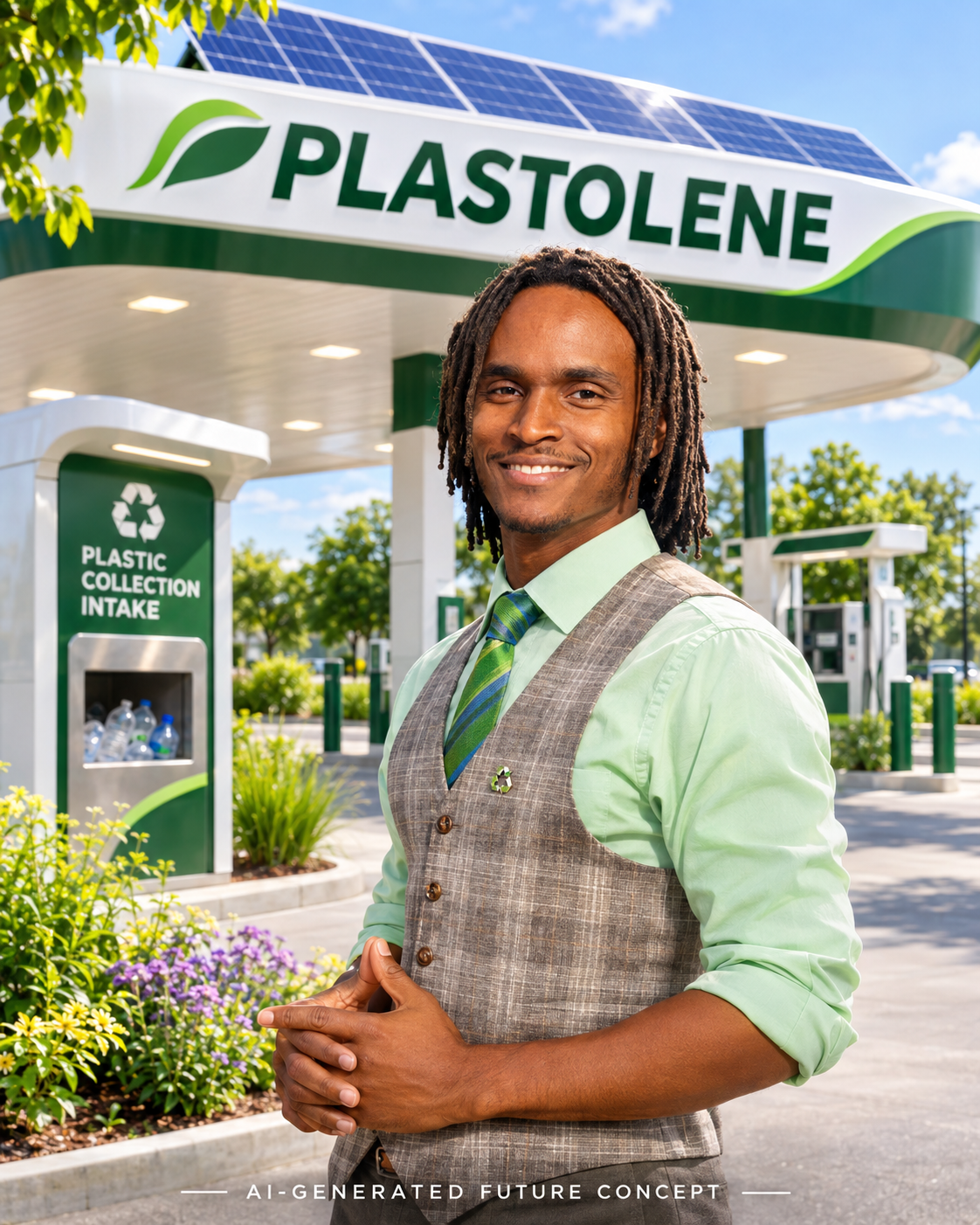
An imagined future station experience. Illustrative concept, not footage of an existing installation.
At fifteen, Julian watched a classroom documentary about plastic pollution. At seventeen, he began building reactors in his parents' backyard.
Julian is the self-taught founder of NatureJAB, exploring how microwave pyrolysis can turn discarded plastic into fuel. His mission brings together hands-on engineering, public demonstrations and the next generation of curious minds.
Read Julian's story in his own wordsImagine a future network of Plastolene® stations across North America. Bring accepted plastic, have it checked and weighed, and receive a credit toward fuel. A better habit could begin with an everyday stop.
A prospective vision from Ken Howard, not an announced NatureJAB expansion plan. No operating network, launch date or rollout commitment is being claimed.
A dedicated intake door welcomes only the plastic types the facility can safely process. Clear guidance makes it easy to arrive prepared.
No price, yield, credit rate or instant conversion is promised. Feedstock screening, safe storage, processing time, fuel specifications, permits and lifecycle impacts all need to be worked out before a station like this could operate.
NatureJAB describes a solar-powered microwave pyrolysis system: heating plastic in an oxygen-limited environment, then collecting and separating the resulting hydrocarbons.
Plastic becomes feedstock rather than something to discard. Material acceptance needs to be established for each system.
Microwave energy helps break long plastic molecules into smaller hydrocarbon molecules inside a controlled reactor.
Vapors are condensed and separated into fuel fractions. NatureJAB calls its plastic-derived fuel Plastolene®.
Fuel demonstrations are one step. Consistent quality, safe operation and measurable performance are the path to practical deployment.
Technology overview, not operating instructions. The source reports 110-octane fuel and zero-emissions processing; this preview does not independently certify those claims. Processing emissions and the emissions from burning the resulting fuel must be evaluated separately.
JAB Innovations documents a succession of designs, including an intermediate Mark 4.5. Each stage adds another piece to the larger ambition.
Early microwave reactor.
Revised geometry and design.
Horizontal layout and auger.
Multiple microwave sources.
Solar, continuous-feed vacuum design.
Mobile solar reactor development.
NatureJAB publishes vehicle fuel demonstrations, including a Dodge Scat Pack and Ford F-250. See the original videos and the context behind each experiment.
Status note: current source pages describe Mark V both as a live offering and as in development. Availability, test results and event logistics should be confirmed with the team. No road-fuel certification is implied here.
Follow the research. Bring the conversation to your community. Help an independent builder take the next step.
The official donation page directs support toward construction, testing and deployment through JAB Innovations.
Visit the official donation pageResearch, conferences, lab visits, media projects and longer-term partnerships are among the sponsorship formats offered.
Explore official sponsorshipsExplore a Julian Brown talk or discuss a reactor demonstration for a school, conference or community event.
Discuss an event with the teamAll participation links open the official sites. This private design preview does not collect payments, bookings or personal information.
A clearer website should make the mission easier to understand and the next questions easier to ask.
No. This is a private, independently prepared gift concept from Ken Howard and Reds for Julian Brown's review. It has not been approved by or published on behalf of NatureJAB.
Earlier coverage uses Plastoline. NatureJAB's current website uses Plastolene®; this design follows that current spelling.
The official sites identify JAB Innovations as the research organization behind the mission and describe it as a 501(c)(3) nonprofit. Consult its official website for current organizational and funding details.
No. Converting plastic and burning the resulting fuel are different stages. Claims about environmental benefits require a full lifecycle assessment, including energy inputs, pollutants, residues and what would otherwise happen to the plastic.
This preview makes no compatibility or safety guarantee. Published demonstrations are not a substitute for applicable fuel standards, independent testing or the engine manufacturer's requirements.
Check the official event listings. No event dates have been copied here because availability can change.